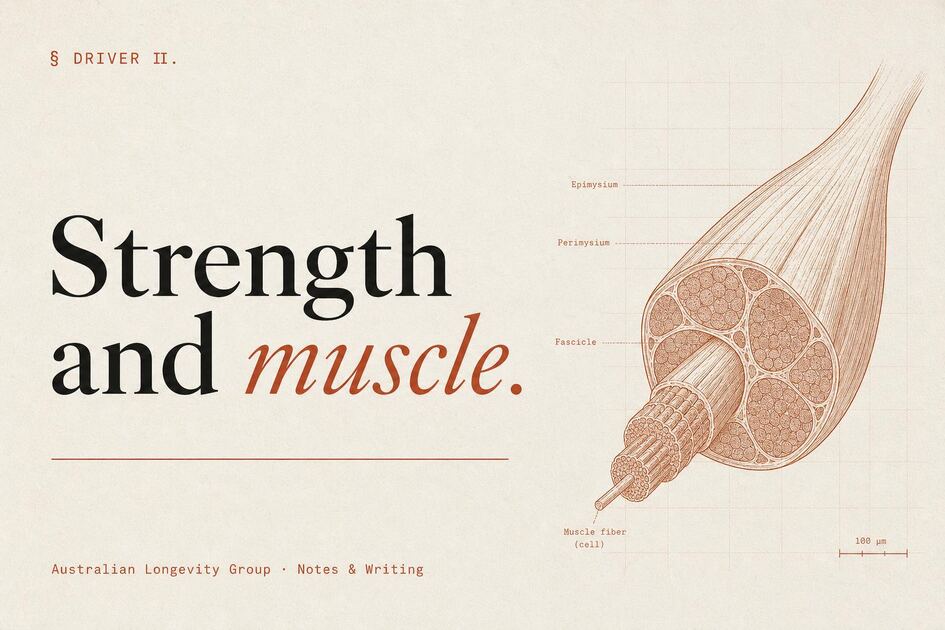
The exercise-and-longevity conversation tends to start and stop with cardio. That misreads the evidence. Strength — how much load a person can move, and how much lean tissue they carry into later life — sits beside cardiorespiratory fitness as a mortality predictor, and probably overtakes it as a predictor of how the last decades are actually lived.
The unglamorous question
For most patients, the real question is not whether they will live to eighty. It is whether they will get up off the floor unassisted at eighty. The data do not blur the two. Lean mass and the strength to use it are what decide.
Grip strength as a vital sign
Of the easy things to measure in a clinic, grip strength is one of the most informative. A simple dynamometer reading tracks cardiovascular disease, all-cause mortality, hospital length of stay, post-operative recovery, and cognitive decline. Grip itself is not doing the protective work — it is a clean window onto whole-body neuromuscular health.
Sarcopenia is not inevitable
Muscle loss with age is the default trajectory but not a fixed one. It can be arrested and partly reversed at almost any age that has been studied. Adults in their seventies and eighties consistently make meaningful gains in strength and lean mass with progressive resistance training. The work is not gentle, and the loads needed to drive adaptation are heavy — not the token weights once prescribed to older adults.
The training
For maximal strength, the highest-yield prescription is heavy compound resistance training at roughly 80% of one-rep max or above, low reps, two or more sessions a week. Lighter loads taken close to failure produce similar hypertrophy but consistently smaller strength gains. The minimum effective dose is modest — a single working set of six to twelve reps at 70–85% of 1RM, two or three times a week — but the dose-response keeps going up with added sets and exposure to heavier loads.
For bone, the prescription is more specific. The LIFTMOR and LIFTMOR-M trials at Griffith University tested supervised heavy resistance and impact training — five sets of five reps of deadlift, overhead press, and back squat above 80–85% of 1RM, paired with jumping chin-ups and drop landings, twice a week for eight months. Postmenopausal women with osteopenia or osteoporosis gained roughly 2.9% at the lumbar spine and 0.3% at the femoral neck while controls lost bone at both sites. Older men in LIFTMOR-M gained 4.1% at the lumbar spine and 2.8% at the trochanter. Compliance was above 90%. Adverse events were minor and rare.
The mechanism is simple: bone responds to brief, heavy, novel loads at the site being loaded. Walking, swimming, cycling, vibration plates, calcium and vitamin D — alone or combined — do not reach the load threshold needed to build new bone. They are baseline adequacy, not therapy. The literature has moved on from light dumbbells and high reps: heavier loads, supervised and progressed carefully, are tolerated by populations once considered too fragile for them, and are the only approach that reliably builds bone at the hip and spine.
Two nutritional supports sit alongside the training. Protein intake of 1.6–2.2 g/kg/day adds to strength and muscle gains, with diminishing returns above about 1.6 g/kg/day in younger adults and a larger required dose with age. Creatine monohydrate at 3–5 g/day is the most consistently supported supplement for high-intensity capacity and lean mass. In adults with low bone density, exercise does the structural work; calcium and vitamin D supply the raw materials and should be addressed alongside the loading, not in place of it.
Protein, plainly
The recommended dietary intake is a deficiency floor, not a target for ageing well. Most longevity-relevant evidence sits in the range of 1.6–2.2 g/kg/day, spread across three or four meals. Responsiveness to a single protein dose declines with age, which is the case for higher per-meal intakes rather than only higher daily totals. The broader dietary context is in the note on nutrition and food systems.
What it earns the patient
A different last decade. The capacity to travel, to lift a grandchild, to recover from the surgery that arrives in most lives eventually, to live independently rather than to be managed. That is what training is actually for.
§ For professionals — mechanisms & evidence+
Grip strength remains one of the most clinically tractable mortality predictors. The PURE study across seventeen countries reported a 16% increase in all-cause mortality per 5 kg decrease in grip strength after adjustment for age, education, employment status, physical activity, and tobacco use 1. The signal is robust across cultures and largely independent of overall body weight.
Sarcopenia is now formally recognised in ICD-10-AM. The European Working Group on Sarcopenia in Older People (EWGSOP2) operationalises diagnosis around low muscle strength, confirmed by low muscle quantity or quality, with severity defined by physical performance 2. The DXA-derived appendicular lean mass index and chair-rise time remain the most usable clinic measures.
Mechanisms
Skeletal muscle functions as the body's largest endocrine organ, releasing myokines (IL-6, irisin, BDNF, decorin, myostatin) that modulate insulin sensitivity, hepatic gluconeogenesis, adipose browning, and neuroprotection. Anabolic resistance — the blunted muscle protein synthesis response to a given protein dose with age — is partially overcome by higher per-meal protein loads (~0.4 g/kg) and by the post-exercise sensitising effect of resistance training 3,4.
Loading prescription for strength
Heavy compound resistance training (≥80% 1RM, 1–6 reps) is superior to lower-load training for maximal strength, while hypertrophy is comparable across the load spectrum when sets are taken near failure 5. Hypertrophy follows a graded dose–response with weekly set volume — approximately 0.37% additional hypertrophy per added set per muscle per week — and twice-weekly per-muscle frequency outperforms once-weekly when volume is equated 6,7. The minimum effective dose for measurable 1RM gain is a single set of 6–12 reps at 70–85% 1RM, 2–3×/wk for 8–12 weeks 8. Early gains (0–6 weeks) are predominantly neural; later gains reflect myofibrillar hypertrophy and pennation-angle change. The NSCA position statement on resistance training for older adults endorses heavier relative loads (70–85% 1RM) over the conventional light-load prescription 9.
Bone
The LIFTMOR trial (n=101 postmenopausal women, T-score <–1.0, mean age 65) tested supervised HiRIT — 5×5 deadlift, overhead press, back squat at >80–85% 1RM plus jumping chin-ups with drop landings, 2×/wk for 8 months. Lumbar spine BMD changed +2.9 ± 2.8% vs −1.2 ± 2.8% in controls (p<0.001); femoral neck BMD +0.3 ± 2.6% vs −1.9 ± 2.6% (p=0.004); femoral neck cortical thickness +13.6% vs +6.3%. A single minor adverse event was recorded; compliance 92% 10. LIFTMOR-M (n=93 men, mean age 67) reproduced the effect: lumbar spine BMD +4.1 ± 0.7% vs +0.9 ± 0.8% in controls (p=0.003), trochanteric BMD +2.8% vs −0.1% (p=0.024), with concurrent gains in lean mass, calcaneal stiffness, TUG, FTSTS, and back and leg extensor strength 11. Long-term multipurpose loading (EFOPS, 16 years, postmenopausal women) reduced low-trauma fractures with a risk ratio of 0.51 (95% CI 0.23–0.97) 12. The mechanism is Frost's mechanostat: brief, high-magnitude, high-rate, site-specific strain drives modelling; sub-threshold or non-weight-bearing modalities do not 13.
What does not work for bone
Calcium supplementation (dietary or supplemental) produces a one-time 0.7–1.8% BMD gain at one year that does not progress meaningfully thereafter 14. Vitamin D supplementation alone produces no clinically meaningful BMD change in non-deficient adults 15. Walking, swimming, cycling, and whole-body vibration are inadequate as primary BMD strategies — strains at the hip during walking sit within the physiological-loading zone and do not reach the modelling threshold. For adults in their thirties with low hip T-scores, peak hip BMD has typically already been attained (FN/total hip ≈ ages 18–21) and the focus shifts to slowing loss and provoking modest osteogenic gain; the mechanostat remains responsive and the prescription is unchanged.
Adjuncts
Protein supplementation augments RT-induced fat-free mass and strength gains, with the FFM benefit plateauing around 1.62 g/kg/day in younger adults and a larger requirement in older adults 16,3,4. Creatine monohydrate (3–5 g/day) is the most consistently supported ergogenic supplement for high-intensity capacity and lean mass 17. Sleep restriction (five nights at 4 h time-in-bed) reduces myofibrillar fractional synthesis rate by roughly 18% in healthy young men 18. Concurrent endurance training produces interference proportional to modality, frequency, and duration; power is most affected, hypertrophy least 19. For falls — distinct from BMD but inseparable from fracture risk — the Otago Exercise Programme reduces fall rates by 32% (IRR 0.68, 95% CI 0.56–0.79) 20, and Tai Chi reduces the number of fallers (RR 0.76, 95% CI 0.71–0.82) 21.
Practical translation
Two to four sessions per week of compound resistance training, progressive overload across the major movement patterns (squat, hinge, push, pull, carry), supported by 1.6–2.2 g/kg/day total protein distributed across three or four meals. For adults with low BMD, the evidence supports a supervised HiRIT/HiPRT package: heavy compound lifting plus impact loading twice a week, sustained for at least eight months, with balance and reactive training added for fall prevention. Calcium, vitamin D, energy availability, and gonadal hormone status should be addressed in parallel — they support but do not substitute for the loading itself.
How much protein should I eat each day?+
Most longevity-relevant evidence in adults sits in the range of 1.6 to 2.2 grams of protein per kilogram of body weight per day, distributed across three or four meals. The standard RDA of 0.8 g/kg is a deficiency floor designed for short-term nitrogen balance, not a target for ageing well.
Why does grip strength predict mortality?+
Grip itself is not doing the protective work. It is a clean, easily measured window onto whole-body neuromuscular health, lean mass, and physical reserve. The PURE study across seventeen countries reported a roughly 16 percent increase in all-cause mortality per 5 kg decrease in grip after adjustment for conventional risk factors.
Can I build muscle in my sixties or seventies?+
Yes. Trials in adults in their seventies and eighties consistently show meaningful gains in strength and lean mass with progressive resistance training. The work is not gentle and the loads are not symbolic. Late-life trainability is one of the more under-appreciated findings in preventive medicine.
Is heavy lifting safe for older adults with low bone density?+
The LIFTMOR trials at Griffith University demonstrated that supervised high-intensity resistance and impact training improved bone density at the lumbar spine and femoral neck in postmenopausal women and older men with osteopenia and osteoporosis, with no fragility fractures observed in the training arms. Loads should be progressed under qualified supervision.
How many resistance training sessions per week are enough?+
Two to four sessions per week, organised around compound movements (squat, hinge, push, pull, carry) with progressive overload, captures most of the available benefit for most adults. The Australian guidelines' minimum of two muscle-strengthening days is a floor, not a target.
- 1. Leong DP, et al. Prognostic value of grip strength: findings from the PURE study. The Lancet. 2015.
- 2. Cruz-Jentoft AJ, et al. Sarcopenia: revised European consensus on definition and diagnosis (EWGSOP2). Age and Ageing. 2019.
- 3. Moore DR, et al. Protein ingestion to stimulate myofibrillar protein synthesis requires greater relative protein intakes in healthy older versus younger men. Journals of Gerontology. 2015.
- 4. Phillips SM, et al. Protein 'requirements' beyond the RDA: implications for optimizing health. Applied Physiology, Nutrition, and Metabolism. 2016.
- 5. Schoenfeld BJ, et al. Strength and hypertrophy adaptations between low- vs high-load resistance training: a systematic review and meta-analysis. JSCR. 2017.
- 6. Schoenfeld BJ, Ogborn D, Krieger JW. Dose–response relationship between weekly resistance training volume and increases in muscle mass: a systematic review and meta-analysis. J Sports Sci. 2017.
- 7. Schoenfeld BJ, Ogborn D, Krieger JW. Effects of resistance training frequency on measures of muscle hypertrophy: a systematic review and meta-analysis. Sports Med. 2016.
- 8. Androulakis-Korakakis P, Fisher JP, Steele J. The minimum effective training dose required to increase 1RM strength in resistance-trained men: a systematic review and meta-analysis. Sports Med. 2020.
- 9. Fragala MS, et al. Resistance training for older adults: position statement from the National Strength and Conditioning Association. JSCR. 2019.
- 10. Watson SL, et al. High-Intensity Resistance and Impact Training Improves Bone Mineral Density and Physical Function in Postmenopausal Women With Osteopenia and Osteoporosis: The LIFTMOR Randomized Controlled Trial. JBMR. 2018.
- 11. Harding AT, et al. Effects of Supervised High-Intensity Resistance and Impact Training or Machine-Based Isometric Training on Regional Bone Geometry and Strength in Middle-Aged and Older Men with Low Bone Mass: The LIFTMOR-M Trial. JBMR. 2020.
- 12. Kemmler W, et al. Long-term exercise and bone mineral density changes in postmenopausal women — are there periods of reduced effectiveness? The Erlangen Fitness and Osteoporosis Prevention Study (EFOPS). Osteoporos Int. 2015.
- 13. Frost HM. Bone 'mass' and the 'mechanostat': a proposal. The Anatomical Record. 1987.
- 14. Tai V, et al. Calcium intake and bone mineral density: systematic review and meta-analysis. BMJ. 2015.
- 15. Reid IR, Bolland MJ, Grey A. Effects of vitamin D supplements on bone mineral density: a systematic review and meta-analysis. The Lancet. 2014.
- 16. Morton RW, et al. A systematic review, meta-analysis and meta-regression of the effect of protein supplementation on resistance training-induced gains in muscle mass and strength in healthy adults. BJSM. 2018.
- 17. Kreider RB, et al. International Society of Sports Nutrition position stand: safety and efficacy of creatine supplementation in exercise, sport, and medicine. JISSN. 2017.
- 18. Saner NJ, et al. The effect of sleep restriction, with or without high-intensity interval exercise, on myofibrillar protein synthesis in healthy young men. J Physiol. 2020.
- 19. Wilson JM, et al. Concurrent training: a meta-analysis examining interference of aerobic and resistance exercises. JSCR. 2012.
- 20. Thomas S, Mackintosh S, Halbert J. Does the 'Otago exercise programme' reduce mortality and falls in older adults?: a systematic review and meta-analysis. Age and Ageing. 2010.
- 21. Chen W, et al. The effects of Tai Chi on falls and fall-related outcomes in older adults: a systematic review and meta-analysis. Front Public Health. 2023.